
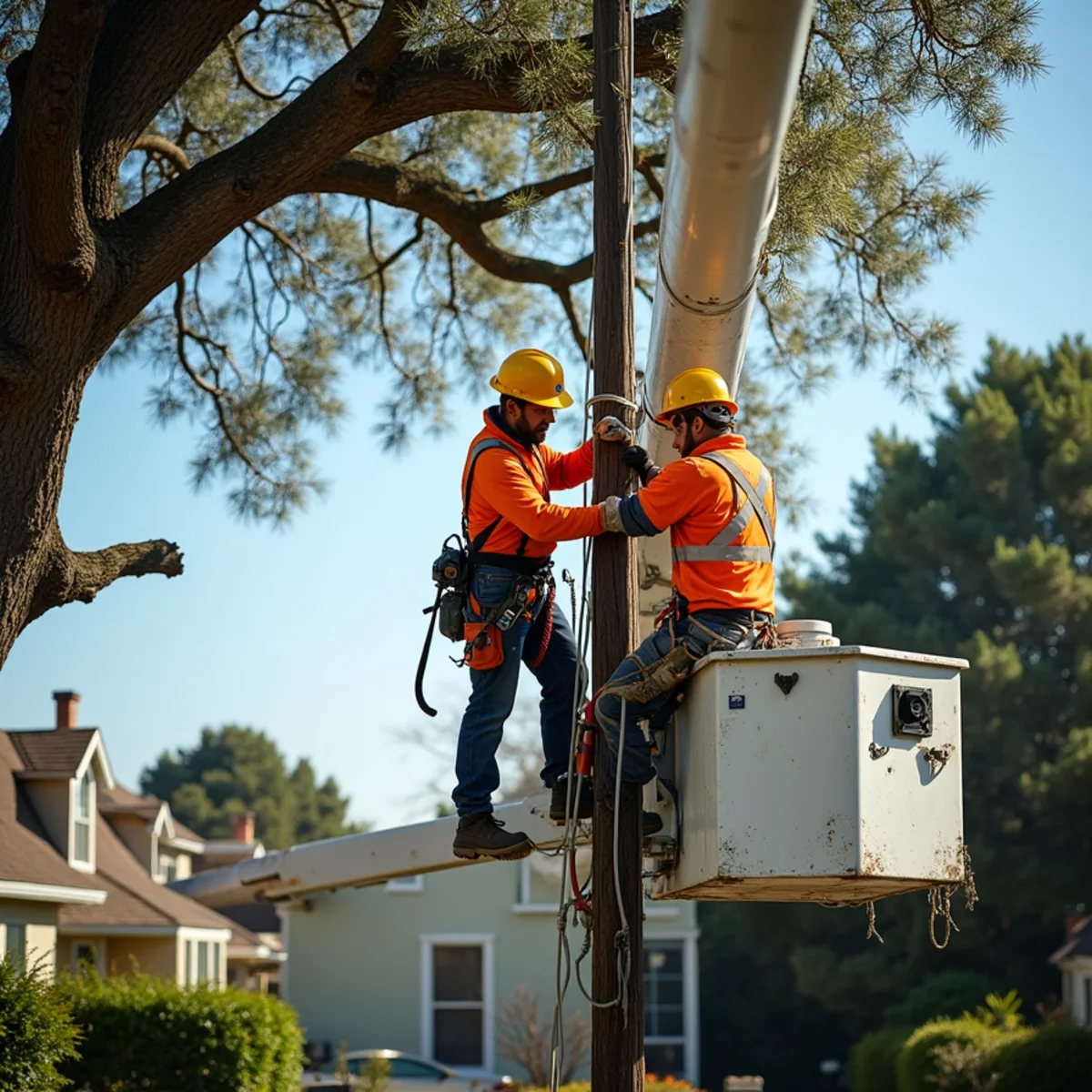
Identifying the Symptoms: When Is Trees Near Power Lines Necessary in Redwood City?
Common Signs & Warning Indicators
- Tree branches actively rubbing, weaving through, or resting upon secondary residential electric service wires
- Visible electrical arcing, flashing sparks, or pungent ozone odor emanating from canopy limbs during breezy weather
- Flickering interior household lights, localized brownouts, or sudden circuit breaker trips during stormy rains
- Noticeable scorch marks, blackened bark, or localized wood burns on branches near overhead utility corridors
- Heavy tree limbs severely pulling down or placing mechanical tension on pole-to-roof service drops
- Rapidly growing suckers and water sprouts extending upward into overhead telecommunication and power lines
Local Peninsula Environmental Triggers
Throughout established Redwood City neighborhoods—from the narrow winding hills of Emerald Lake Hills to the tree-lined avenues of Mount Carmel—dense canopies of coast redwoods, eucalyptus, and mature oaks coexist with aging overhead utility infrastructure. During winter rainstorms, saturated foliage gains tremendous weight, causing branches to sag directly onto electric conductors. In summer, coastal thermal drafts blow dry branches into power lines, creating serious electrical fire hazards under California Public Utilities Commission (CPUC) General Order 95 parameters.
Under California law and local municipal ordinances, property owners bear legal responsibility for hazardous trees that threaten adjacent roadways, sidewalks, power lines, or neighboring structures. Early intervention by an ISA Certified Arborist prevents emergency failures during severe coastal weather.
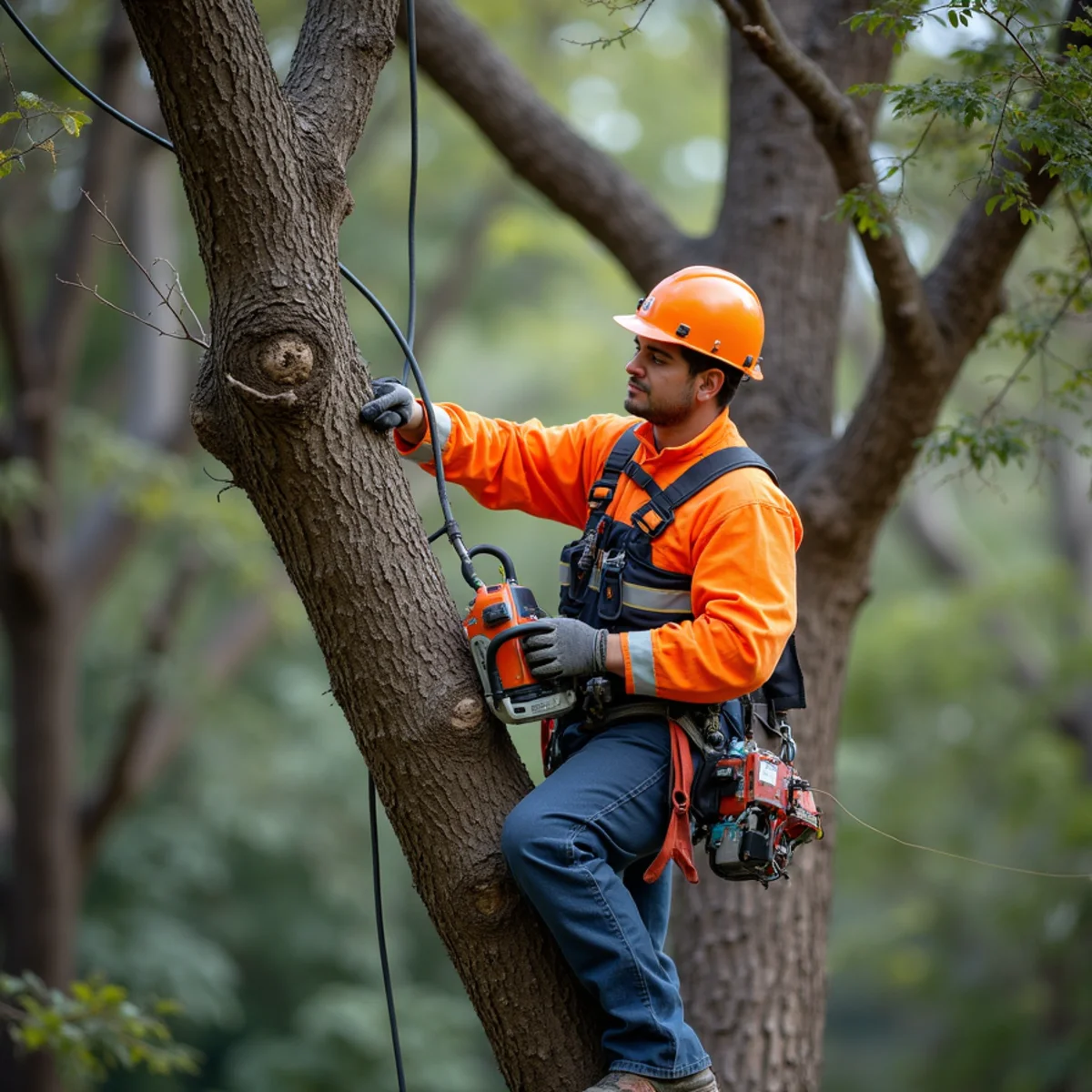
What to Do First: The First-30-Minutes Tree Emergency Checklist
When a storm strikes or a tree fails, prioritize human safety before initiating cleanup. Follow these essential field steps:
Action Checklist Before Cleanup
- 1Stay away! Never approach within 30 feet of any tree, fence, or ground surface in contact with a downed or arcing electrical wire.
- 2Assume all overhead wires are energized and lethal—do not attempt to touch, push, or trim branches using pruners, aluminum ladders, or wooden poles.
- 3If you see active sparks, smoke, or fire on a tree touching wires, call 911 immediately, then call PG&E's emergency line at 1-800-743-5000.
- 4If the tree is encroaching on your residential house-drop without active sparks, keep pets and children clear of the yard sector.
- 5Call Honey Bear Trees at (213) 468-5153 to schedule an arborist line clearance evaluation and utility-drop coordination plan.
What to Tell Our Dispatcher
Having these property details ready helps us deploy the appropriate crane, rigging blocks, or line-clearance equipment immediately:
- Exact property address and location of utility wire (front curb, side driveway, back alleyway)
- Is the wire a primary street power line, a house service drop, or a telephone/cable communication wire?
- Are you observing active sparks, smoke, scorch marks, or buzzing electrical sounds?
- Approximate tree species and branch diameter encroaching within the 3-foot clearance zone
- Vehicle access for insulated aerial bucket trucks or compact backyard spider lifts
Common Tree Hazards in Redwood City: Causes, Signs & Immediate Safety Steps
Use this diagnostic reference to identify hazardous structural conditions and coordinate safe next steps without putting family or property at risk:
| Cause | Warning Signs | Immediate Response | Who to Call | Documentation |
|---|---|---|---|---|
| Secondary Residential Service Drop (120V / 240V Pole-to-House) | Branches rubbing against insulated triplex cable connecting street pole to your home electrical weatherhead | Do not attempt DIY trimming; avoid touching the metal weatherhead conduit or guttering | Call Honey Bear Trees at (213) 468-5153 for licensed residential service-drop clearance trimming | Photograph the branch contact point against the wire from a safe ground perspective |
| Primary High-Voltage Utility Distribution Line (4kV – 21kV Street Overhead) | Limbs within 10 feet of bare overhead wires mounted on highest crossarms along public street easements | Maintain a minimum 30-foot perimeter distance; warn neighbors and pedestrians to stay clear | Call PG&E directly at 1-800-743-5000; California law requires PG&E line-clearance certified crews for high-voltage corridors | Note pole ID numbers painted on the nearest wooden utility pole for the PG&E dispatcher |
| Telecommunication & Fiber Optic Cable Encroachment (Comcast / AT&T) | Thick black bundled cables mounted lowest on the pole sagging under heavy branch foliage | While these lines do not carry high voltage, they often share poles with electrical conductors; do not pull lines | Call Honey Bear Trees at (213) 468-5153 for routine clearance pruning to prevent internet outages | Check whether individual communication lines are abraded or pulled loose from exterior house siding |
| Broken Hanging Branch ('Widow-Maker') Resting on Power Line | Snapped limb suspended mid-air directly bridging two electrical conductors or hanging over service drop | Evacuate area beneath and around the wire span; ground may become energized if the wire snaps under weight | Call 911 if sparking occurs, then call PG&E (1-800-743-5000) and Honey Bear Trees (213) 468-5153 | Capture photos showing branch size, wire deflection angle, and proximity to buildings |
| Tree Trunk Growing Against Utility Pole or Guy Wire | Tree bole physically pushing or bowing utility pole, or swallow-tail growth embedding steel anchor guy wires | Do not cut roots or girdle trunk without utility engineering review; pole stability may be compromised | Call Honey Bear Trees to coordinate a joint site inspection with municipal and utility engineers | Photograph trunk contact with pole base, guy wire angle, and any visible pole tilt |
Request an On-Site Assessment for Trees Near Power Lines
Speak with our local Redwood City dispatch team at (213) 468-5153 to discuss your tree situation and schedule an arborist evaluation.
Our Methodological Standards for Trees Near Power Lines
Our ISA Certified Arborists perform a strict two-stage electrical proximity evaluation. First, we identify whether the encroaching line is a primary high-voltage transmission/distribution line (which requires PG&E utility tree contractors) or a secondary 120V/240V residential service drop running from the street pole to your home weatherhead (which is the property owner's legal responsibility). Second, we measure radial clearance distances and formulate an insulated aerial clearance plan complying with Cal/OSHA Title 8 High Voltage Electrical Safety Orders.
Non-Conductive Insulated Aerial Clearance Pruning
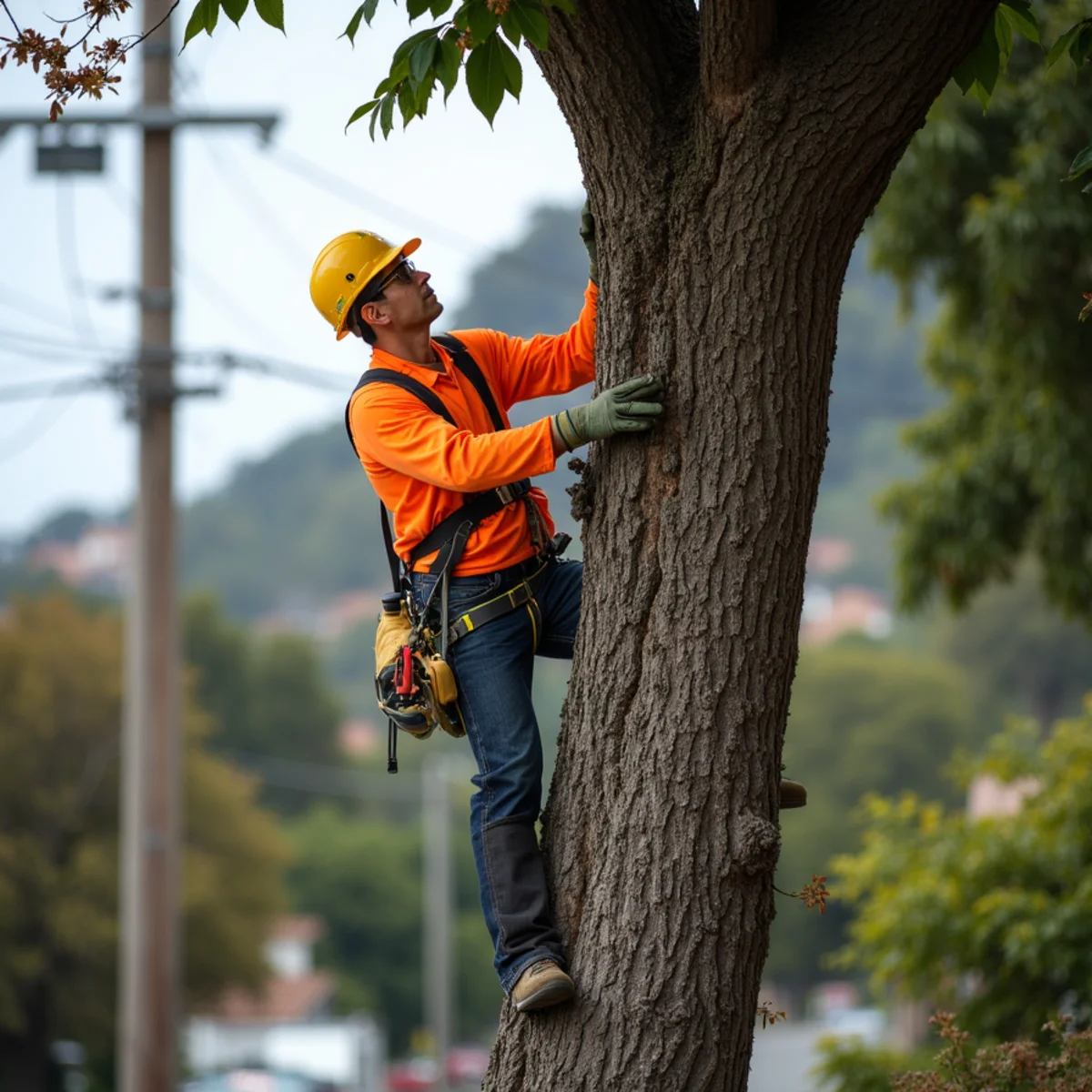
Our certified arborists use dielectric fiberglass poles and hydraulic pruning tools tested to withstand high voltages. We selectively prune branches around residential service drops without allowing tools, ropes, or cut timber to bridge electrical lines.
PG&E Temporary Disconnect & Re-Energization Coordination
When heavy tree limbs are hopelessly entangled or resting directly on the service drop, we coordinate with PG&E to temporarily disconnect power to the house. Our crew rapidly clears all timber from the wire pathway, allowing PG&E to safely restore power the same day.
Directional Utility Clearance Pruning (ANSI A300 Part 1)
Rather than indiscriminately lopping off branch ends—which triggers rapid, weak sucker regrowth toward wires—we prune limbs back to sound lateral branch collars directed away from utility corridors, training the canopy to grow outward rather than upward into wires.
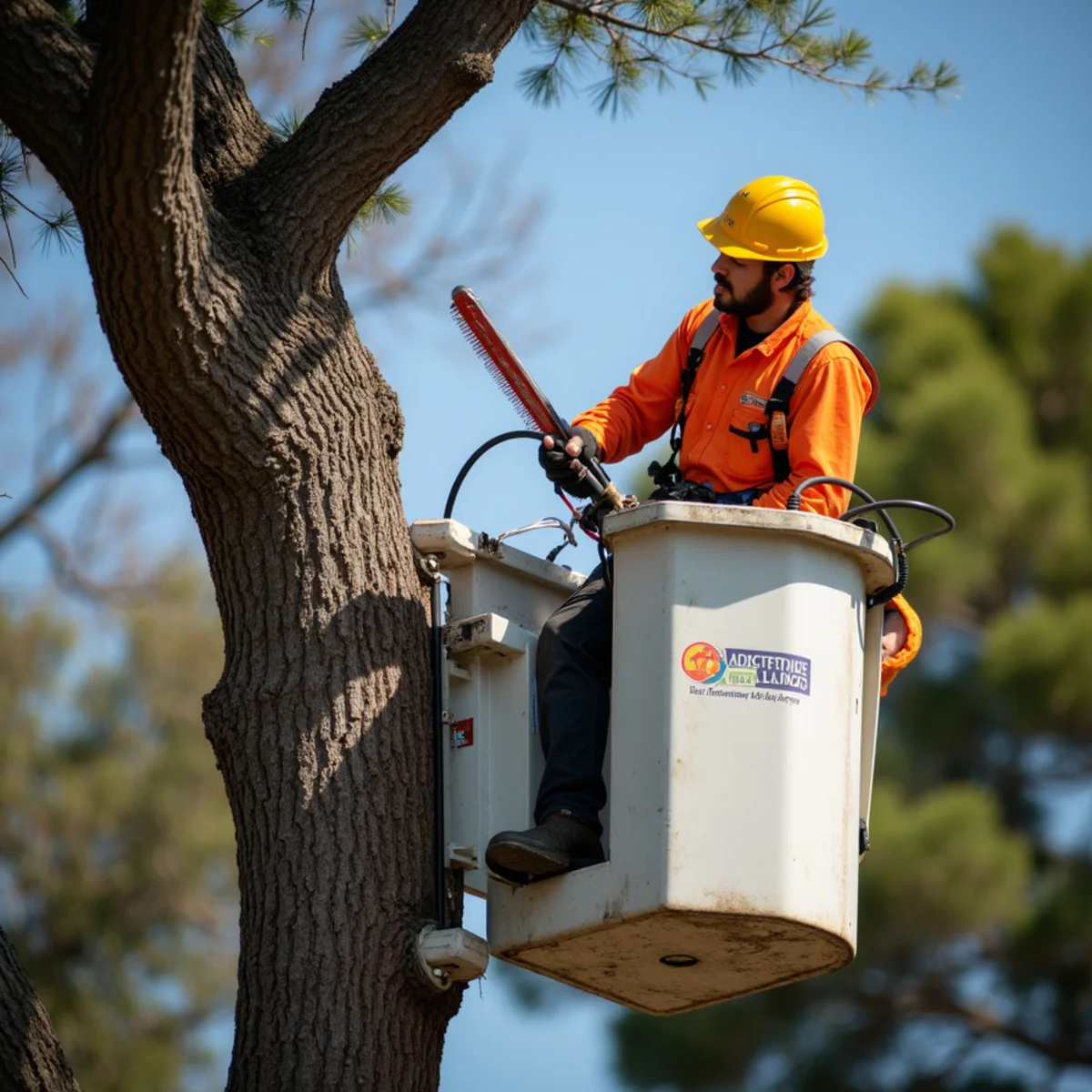
Step-by-Step Execution: From Inspection to Final Cleanup
Voltage Identification & Ownership Triage
An ISA Certified Arborist inspects the site to determine whether encroaching wires are utility high-voltage primary lines, secondary service drops, or communication lines, establishing legal responsibility.
Clearance Plan & Utility Notification
We establish required clearance distances under CPUC General Order 95 and determine whether a temporary PG&E service drop disconnect is required for worker and property safety.
Ground Safety Perimeter & Grounding Setup
Our team establishes a secure drop zone beneath the utility corridor, laying protective ground mats and ensuring no conductive metal tools enter the work sector.
Aerial Non-Conductive Precision Pruning
Using insulated bucket trucks or non-conductive climbing gear, arborists execute clean ANSI A300 directional cuts to establish a minimum 3-to-5-foot buffer zone around service wires.
Controlled Rigging & Timber Lowering
Cut limbs are rigged with specialized taglines to pull wood systematically away from electrical wires, lowering each piece safely to the ground without touching conductors.
Debris Chipping, Clean-up & Line Inspection
All trimmings are converted into organic mulch and hauled away. We inspect the cleared wire span to verify proper tension, absence of abrasion, and full clearance.
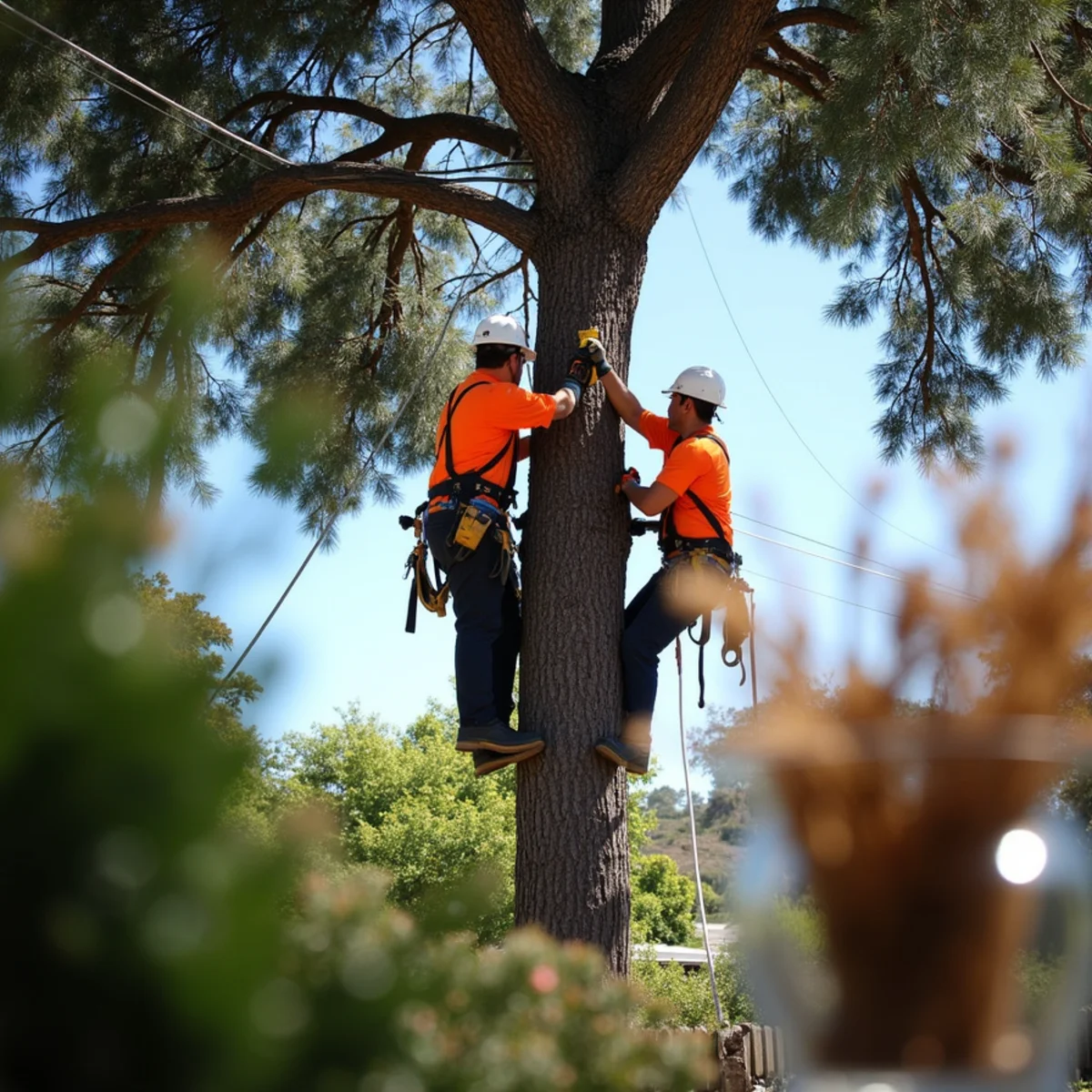
How Much Does Tree Service Cost in Redwood City?
In accordance with California consumer protection standards, we do not quote arbitrary flat rates. Every estimate is custom-engineered based on the physical realities of your property:
Secondary 120/240V wire, bucket truck accessible driveway, establishing 3-to-5-foot clearance, brush chipping.
Large heritage oak or pine canopy overhanging service drop, manual climbing with insulated non-conductive rigging.
Heavy limbs heavily entangled in house service drop requiring PG&E temporary disconnect and same-day re-energization.
Complete dismantling of compromised tree adjacent to utility corridors utilizing aerial friction lowering and rigging.

Local Species & Redwood City Neighborhood Risk Profiles
Every Redwood City neighborhood presents distinct geological, architectural, and access dynamics that dictate equipment staging and rigging methods:
Steep hillside topography with narrow private lanes and overhead utility lines traversing densely wooded parcels.
Tall Monterey pines and blue gum eucalyptus limbs swaying heavily during winter storms across backyard service drops.
Flat urban valley loam with compact residential lot lines and high-density overhead utility pole networks.
Fast-growing Chinese elms, fruit trees, and privets growing unchecked into low-hanging service drops and communication bundles.
Elevated ridgeline with shallow soils and extreme afternoon wind exposure off the coastal mountain gaps.
Sudden branch drop from mature coast live oaks snapping across street lines and driveway power drops.
Mature residential streetscapes with deep alluvial loam supporting 80-foot street trees beside residential roofs.
Heavy sycamore and redwood branches growing directly around house weatherheads and secondary power drops.
Key Tree Species Considerations in Redwood City
Coast Redwood (*Sequoia sempervirens*)
Rapid vertical shoot and lateral branch extension into utility corridors; fibrous bark can collect electrical carbon tracking.
Monterey Pine (*Pinus radiata*)
Brittle resinous branches prone to sudden snapping during windstorms; needles ignite easily if touching live arcing wires.
Blue Gum Eucalyptus (*Eucalyptus globulus*)
Massive volatile limbs laden with combustible oils; rapid seasonal growth rates quickly exceed safe utility clearances.
Siberian Elm & Tree of Heaven (*Ailanthus altissima*)
Aggressive, weak-wooded adventitious growth directly through utility wire spans, causing repetitive seasonal line contact.
Municipal Permit Compliance & Contractor Credentials
Cal/OSHA Title 8 High Voltage Electrical Safety Orders (Section 2940.2) strictly prohibit uncertified individuals or tools within 10 feet of energized high-voltage utility lines. Under California Public Utilities Commission (CPUC) General Order 95 Rule 35, utility providers maintain primary distribution lines, whereas homeowners are responsible for maintaining safe clearances along their secondary service drops connecting to private structures. Honey Bear Trees complies fully with Redwood City tree trimming standards and ANSI A300 pruning specifications.
Questions to Verify Before Hiring Any California Tree Service Contractor:
- Cal/OSHA Title 8 High Voltage Compliance: Strict adherence to California safety standards governing clearance distances and non-conductive gear near power corridors.
- Dielectric Insulated Equipment: Use of fiberglass pole pruners, insulated aerial bucket booms, and synthetic non-conductive rigging lines tested to ASTM standards.
- California State Contractors License (CSLB): Active C-61 / D49 Tree Service specialty contractor license (Honey Bear Trees Lic #1084291) in full standing.
- $2,000,000 Commercial Liability & Workers' Comp: Comprehensive insurance coverage explicitly protecting residential property and utility infrastructure from electrical accident liability.
- Direct PG&E Utility Coordination Expertise: Established protocols for scheduling temporary service-drop disconnects and re-connections with PG&E regional dispatchers.
Frequently Asked Questions About Trees Near Power Lines
PG&E is legally responsible under California Public Utilities Commission regulations for maintaining tree clearance around high-voltage distribution lines along streets. However, the homeowner is legally responsible for maintaining clearance around the secondary service drop wire that runs from the utility pole directly to your home weatherhead. Honey Bear Trees safely prunes trees around residential service drops.
Related Tree Services, Local Guides & Service Areas
Helpful Tree Care Articles
Primary Service Locations
Get a Free Estimate for Trees Near Power Lines
Call (213) 468-5153 to speak directly with our arborist team. We answer calls around the clock and provide fast on-site evaluations across Redwood City and San Mateo County.